
Good, not Great
How to approach a new year...

In the car, while listening to NPR, I heard an interview recently with the singer-songwriter Maggie Rogers, who took some time away from her career to study the intersection of religion and public life. I can’t say that I know her music, but I was intrigued that in the course of the interview she said that her studies had allowed her to reflect on some big questions, including this one: “how do I use the work that I love to do the most amount of good in the world.”
I didn’t know that I was looking for a framework to use for the approach to this new year, but, in fact, I was. And a pretty good one is contained in Maggie Rogers’s question when I turn it into a statement: I want to do the most good I possibly can with the gifts and resources that I have at my disposal.
My own reflection about how to approach the year ahead of me was aided by the encouragement of someone dear to me who knows that I have been frustrated by the process of looking for a job, which has been going on for many months now. I won’t bore you with the details of my frustration, and how that frustration undermines one’s self-esteem. It’s a bit of a battle, which, like all battles, seems to get worse the longer it drags on. But I have this friend who is particularly adept at building me up and preparing me for victory, even when I can’t see it. That friend challenged me to think about things I can essentially build or initiate myself, knowing that I have built and initiated a good many things in the past. When I started to try to respond to that challenge, I quickly recognized how much I want to borrow Maggie Rogers’ question and turn it into a framework for myself for 2025. I want to do the most good I possibly can with the gifts and resources that I have at my disposal. I am already in discussions with several people about how to turn this outlook into action, and I am hopeful that something will come of at least one of these discussions.
Here’s the crucial thing: doing good.
I have told students at St. James School before that I am not necessarily expecting any of them to do great things, and that I am not especially concerned with whether or not any of them ever turns out to be a great person. I hope such a statement sounds a little bit provocative, but only a little. I think there is limited value to expressions of the expectation of greatness that are directed to middle schoolers. But I am deeply concerned about another expectation, I told those students; I am deeply concerned about that expectation that each and every one of them should be good. I want desperately for every child who is part of the life of that fine school to be firmly set on a path to goodness, and to be self-aware about the call to be good. It was in middle school that I remember being taught that the highest expectation that I or others could make of myself was an entirely reasonable expectation: that I should grow up to be a good man. I want the kids I care about to grow up to be good not great. If any of them should end up being great, then thank God for it; but goodness will do.
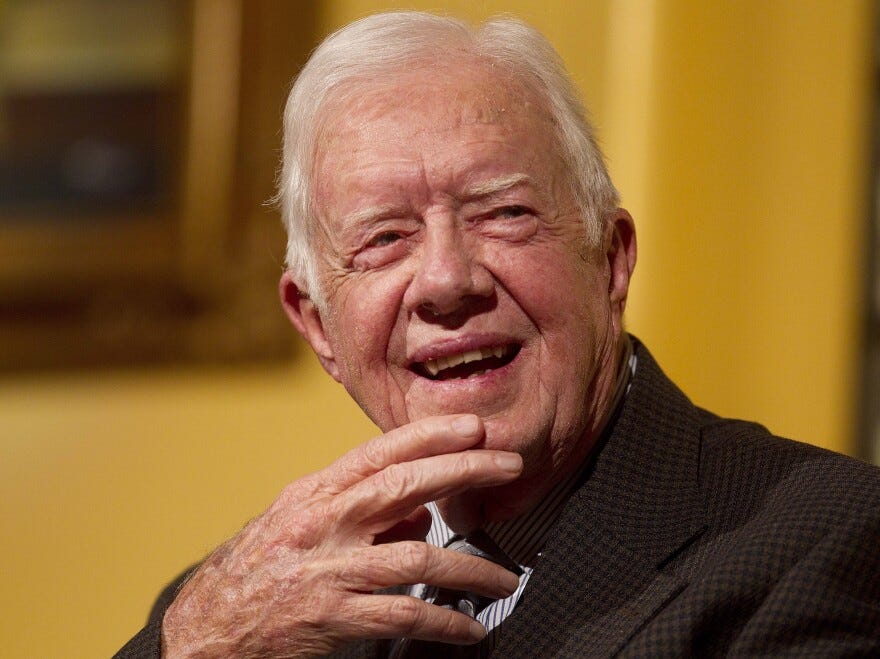
The reflections I’ve heard about Jimmy Carter these past days seemed to articulate this distinction pretty well. It is possible that Jimmy Carter was not a great president. We could argue about such an evaluation, and take note that many of his accomplishments as president were significant. What strikes me most about Jimmy Carter is this, that after his presidency, he seemed to forego any preoccupation with greatness, and focused all his considerable gifts on goodness, instead. And I would say that Jimmy Carter’s life is a testament to how goodness surpasses greatness as an aspiration for most of us. After all, most of us have a very real shot at being good, although greatness, by definition, will be achieved by only a few. I think Jimmy Carter accomplished more as a good man than he did as president. And I also think that his example has mattered.
Part of what I heard when I tried to discern what God was calling me to do as a young man was an answer to this question that I’m now borrowing from Maggie Rogers: how could I find work that I love in order to do the most amount of good in the world? I believed that a vocation to ministry in the church allowed me to answer that question well. And I’d have said that I have nearly twenty-eight years of ministry suggesting that I was not entirely wrong in that assessment. I admit that I have been confused throughout much of 2024 by what feels like a radically different assessment of all those years of ministry that looked mostly fruitful to me. But I suppose that’s a topic for another time. And it’s a big reason that I have had to spend some real time and energy looking for a framework with which to approach 2025.
At the start of a new year, I am seeing - and I want to encourage you to see too - that Maggie Rogers was onto something very helpful when she posed that question, “how do I use the work that I love to do the most amount of good in the world?” It’s a question whose usefulness holds up even when everything else is in turmoil; that’s the context in which I heard it.
Anyone who wants to commiserate with me about searching for a job is welcome to do so, especially if you happen to be in your late 50s. And let me say, that I realize that it is only because I am coming from a position of remarkable privilege that I have the luxury of taking time to work out an emotional, vocational, and professional posture for myself. Most working people don’t get to take the time to ask questions like these. Having been given the privilege, I want to use it, not waste it.
As we launch into 2025, I am clear (once again) that I want to do the most good I possibly can with the gifts and resources that I have at my disposal. Goodness surpasses greatness as an aspiration for most of us. When I find new ways of doing good that I think I should share with you, I promise I will. Maybe we’ll do some good together this year!
Beautiful Sean. Thank you!
Another good piece that gives us something to think about.